“Prévenir pour préserver” round table — Saturday 31 October 2026, 2:30 pm, Résidence Rose (Avénou)

+228 70 20 20 06
Togo en RoseGFVD-GL
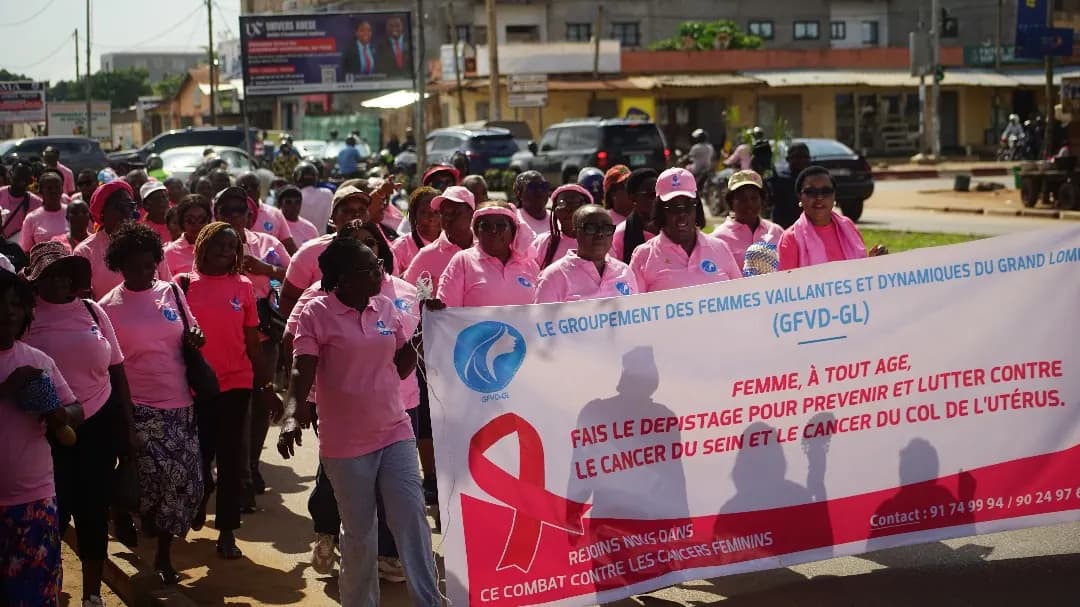
GFVD-GL banner carried in the procession: “Women, at any age, get screened to prevent and fight breast cancer and cervical cancer”

Screening & support

Getting screened gives you every chance

When found early, breast and cervical cancers are much easier to treat. Cervical screening even makes it possible to treat lesions before they turn into cancer.

Why get screened?

Screening is for women who feel healthy. That is precisely what makes it so powerful.
  • Act before symptoms appear

    In their early stages, these cancers often cause no pain and no signs. Screening finds them at a stage when treatment is simpler and more effective.

  • Stop a cancer from developing

    For the cervix, screening finds precancerous lesions. Treating them prevents cancer from developing.

  • Peace of mind and good information

    A normal result brings peace of mind. And the visit is a chance to ask a health professional all your questions.

Who and when?

Recommendations differ depending on the cancer. Here are the World Health Organization’s guidelines.

Breast cancer

Know your breasts, see someone at the slightest change

  • At any adult age: know what your breasts normally look like and see someone promptly if you notice a change (a lump, an inverted nipple, discharge, orange-peel skin…).
  • During a visit, a trained professional can carry out a clinical breast examination, depending on the services available.
  • Where it is available, the WHO recommends screening mammography every two years between the ages of 50 and 69.
  • Family history of breast cancer? Talk to a doctor: suitable follow-up may be offered.

Cervical cancer

From age 30, regular screening

  • From age 30: regular screening, every 5 to 10 years with an HPV test.
  • Women living with HIV: from age 25, every 3 to 5 years.
  • Depending on the services available, screening is done with an HPV test or with visual inspection with acetic acid (VIA), usually repeated every 3 years.
  • Even if you are vaccinated or have no symptoms, screening is still recommended.
These guidelines are general. The health worker will adapt how often you are screened to your situation and your results.

What happens during a screening visit?

A visit usually takes less than an hour, including waiting time. Here are the usual steps.
  1. Welcome and conversation

    A health worker asks you a few questions: age, pregnancies, medical history, any symptoms. Everything you say remains confidential.

  2. Breast examination

    Depending on the services available, the health worker looks at your breasts and then feels them, as well as the armpits, for anything unusual. Use the opportunity to ask her to show you how to self-examine.

  3. Cervical examination

    While you lie down, the health worker inserts a speculum to see the cervix, then performs VIA or takes a sample for an HPV test. The examination takes only a few minutes.

  4. Results and advice

    With VIA, the result is known straight away. For an HPV test or a Pap smear, you are told when and how to collect the result.

  5. Follow-up if needed

    If something abnormal is found, treatment may be offered on site depending on the centre, or you will be referred to a specialist service. Our team can support you through these steps.

Pink October

Screening days at the heart of our events

Every year during Pink October (Octobre Rose), GFVD-GL and its partners reach out to women and organise breast and cervical cancer screening sessions, free of charge [TO BE CONFIRMED for each event].

On 21 October 2025, the Grande Marche Rose (Great Pink March) led participants from the headquarters of the Togolese Football Federation in Kégué to the Maison de la Sage-Femme in Hédzranawoé, where screening was offered on arrival.

The dates, places and conditions of upcoming sessions are announced on our Events page and by phone.

Poster for the Grande Marche Rose on Tuesday 21 October 2025, followed by breast and cervical cancer screening

Find a screening centre

Filter by region and by service. Remember to call the centre before you travel to check its days and opening hours.

1 centre found

  • To be confirmed

    Maison de la Sage-Femme de Hédzranawoé

    Lomé · Maritime

    Services
    Breast cancerCervical cancer
    Address
    Hédzranawoé, Lomé [TO BE CONFIRMED: exact address]
    Opening hours
    To be confirmed
    Phone
    To be confirmed

    Finishing point of the Grande Marche Rose on 21 October 2025, where breast and cervical cancer screening was offered. Call our helpline (+228 70 20 20 06) for upcoming screening dates.

    Details are being checked: please call before you travel.

This list is being updated. Do you know a centre that offers screening? Let us know by phone. +228 70 20 20 06

A question before getting screened?

Our team listens, informs and guides you. You are not alone.

Sources

The information on this page is based on publications by the World Health Organization (WHO) and the International Agency for Research on Cancer (IARC).

  1. World Health Organization — Cervical cancer, fact sheet (opens in a new tab) — OMS / WHO
  2. WHO — Guideline for screening and treatment of cervical pre-cancer lesions for cervical cancer prevention, 2nd edition (2021) (opens in a new tab) — OMS / WHO
  3. World Health Organization — Breast cancer, fact sheet (opens in a new tab) — OMS / WHO
  4. WHO — Global Breast Cancer Initiative (opens in a new tab) — OMS / WHO

Content reviewed on 3 October 2026